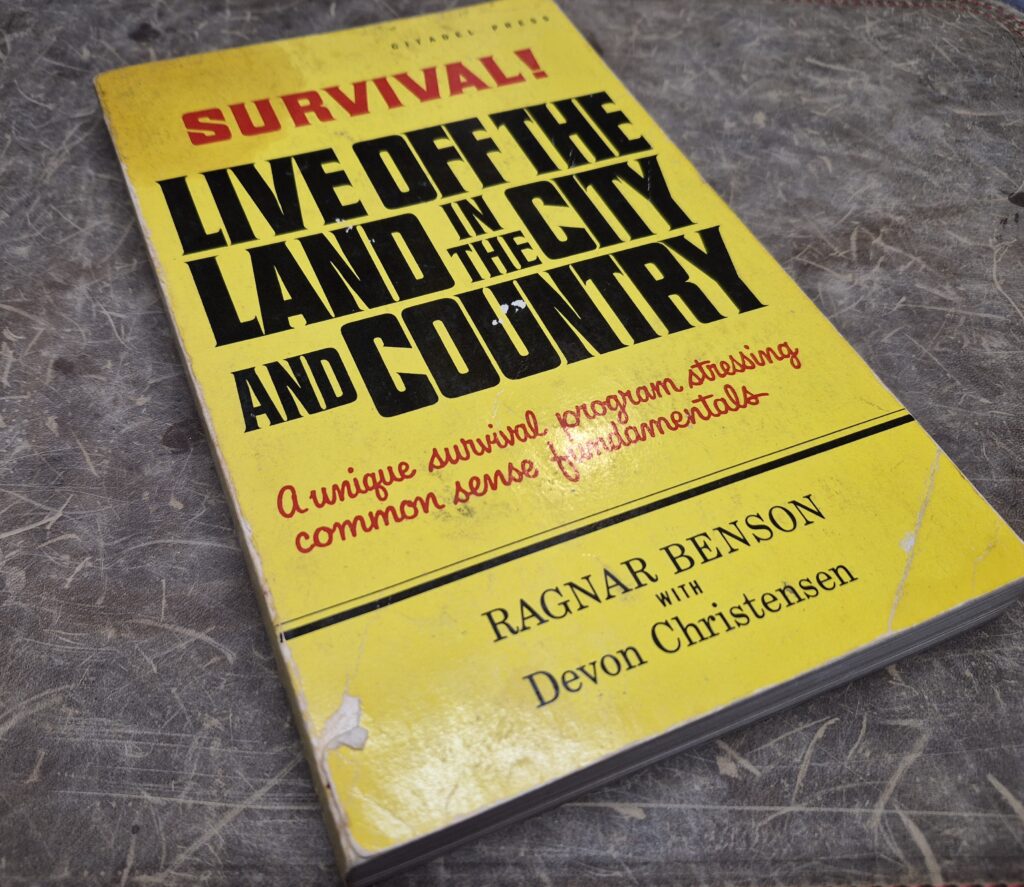
I first learned about building caches in Live Off the Land in the City and Country by Ragnar Benson. I bought that book new in 1982 or 1983. It was one of the first survival manuals I ever owned, and I’ve torn through it countless times.
Building Your Emergency Cache
Caching is a concept that’s been around for a very long time. The basic idea is to stash gear and supplies in a hidden location so that they can serve as either a resupply point or a backup to your primary equipment. This presupposes that your cache remains undiscovered as well as undamaged between the time you place it and when you go to retrieve it.
Advertisement — Continue Reading Below
Let’s look at some logistics.
Cache Container
Traditionally, these sorts of caches are buried, so the container needs to be able to withstand the pressure and weight of the soil above and around it. While there are numerous ways to pull this off, one of the most common approaches is to use PVC pipe as the cache container. That’s what was recommended in Ragnar Benson’s book forty-odd years ago, and it’s still a workable solution today.
Advertisement — Continue Reading Below
What works well is to use a layered approach where two pipes are used, one within the other. The cache pipe is typically buried vertically, so that it’s more difficult to detect. Over time, dirt compacts around that pipe, and when the time comes to remove it, the job could be very difficult. But if you put the actual cache pipe inside a slightly larger one that’s sealed with a screw-on lid, then all you need to do is open the top and pull out your gear.
Cache Contents
The biggest rule of caching is never put anything in a cache that you’re not comfortable never seeing again. This isn’t the place for treasured family heirlooms or anything exceptionally valuable. Instead, think along the lines of you’re down to nothing, and you desperately need to resupply as you travel from Point A to Point B. What would you want or need?
Advertisement — Continue Reading Below
Here are a few common cache additions:
- Water filter, like a Sawyer Mini
- Decent knife
- Map and compass
- Fire kit
- Mylar blanket
- Cordage
- Fishing kit
- Snare wire
- First aid kit
I know people who have cached firearms and ammunition as well.
Cache Locations
This is perhaps the trickiest part of the equation. The cache should be buried in a location that’s unlikely to be disturbed by construction projects, ideally on land to which you have legal access. If you trespass onto private property to retrieve your cache, this could be detrimental to your health.
Advertisement — Continue Reading Below
I’ve come across suggestions to bury your cache at the edge of a cemetery. I can’t stress enough how bad of an idea this is. Imagine the authorities catch you lurking in the cemetery in the middle of the night…with a shovel. That’s not going to end well, other than the story those officers will be able to tell for years to come.

When you do bury the cache, it should be well below the frost line. Consider scattering some metal junk a few inches above the cache as you bury it. This way, if someone were to come across the location while using a metal detector, they’ll assume those bits are what they found.
Advertisement — Continue Reading Below
Wherever you decide to put it, make absolutely certain you’ll be able to find it again. GPS coordinates are great, but you might not have a working GPS unit when you go to retrieve the cache. Rely on landmarks that aren’t likely to move, such as large boulders or trees. One option a guy I knew was using was to use concrete to cast a unique-shaped rock of sorts that he’d place over the cache location.
Ways This Can Go Wrong
If you’re going to invest the time, energy, and expense into caching supplies, it’s important to go into this with both eyes wide open. There are a number of ways this can go awry.
- The cache could be found by someone else and taken.
- The cache location could be dug up for new construction.
- You might not remember exactly where it is and never find it again.
- The seals on the container may fail, allowing moisture to foul the contents.
- You might not be able to reach the location for any number of reasons.
- You might get there, successfully dig it up, then be unable to open it.
- You might be discovered whilst burying it or digging it up.
Granted, any prep plan is subject to the fickle finger of fate. But this one in particular has a lot riding against it. That said, it isn’t the worst idea to use a cache as a backup to your backups.
Advertisement — Continue Reading Below