What is a lever-action rifle without a revolver as a companion? Henry Repeating Arms has dominated the lever-action rifle market for over two decades, and it was no surprise that they would enter the revolver market. Unlike Winchester in the 19th century, Henry was not bound to some handshake agreement with a revolver maker. The release of their single-shot rifle was a tell at things to come. But when the Henry Big Boy revolver hit the market in 2023, I was not ready for it.
Henry Golden Boy Revolver
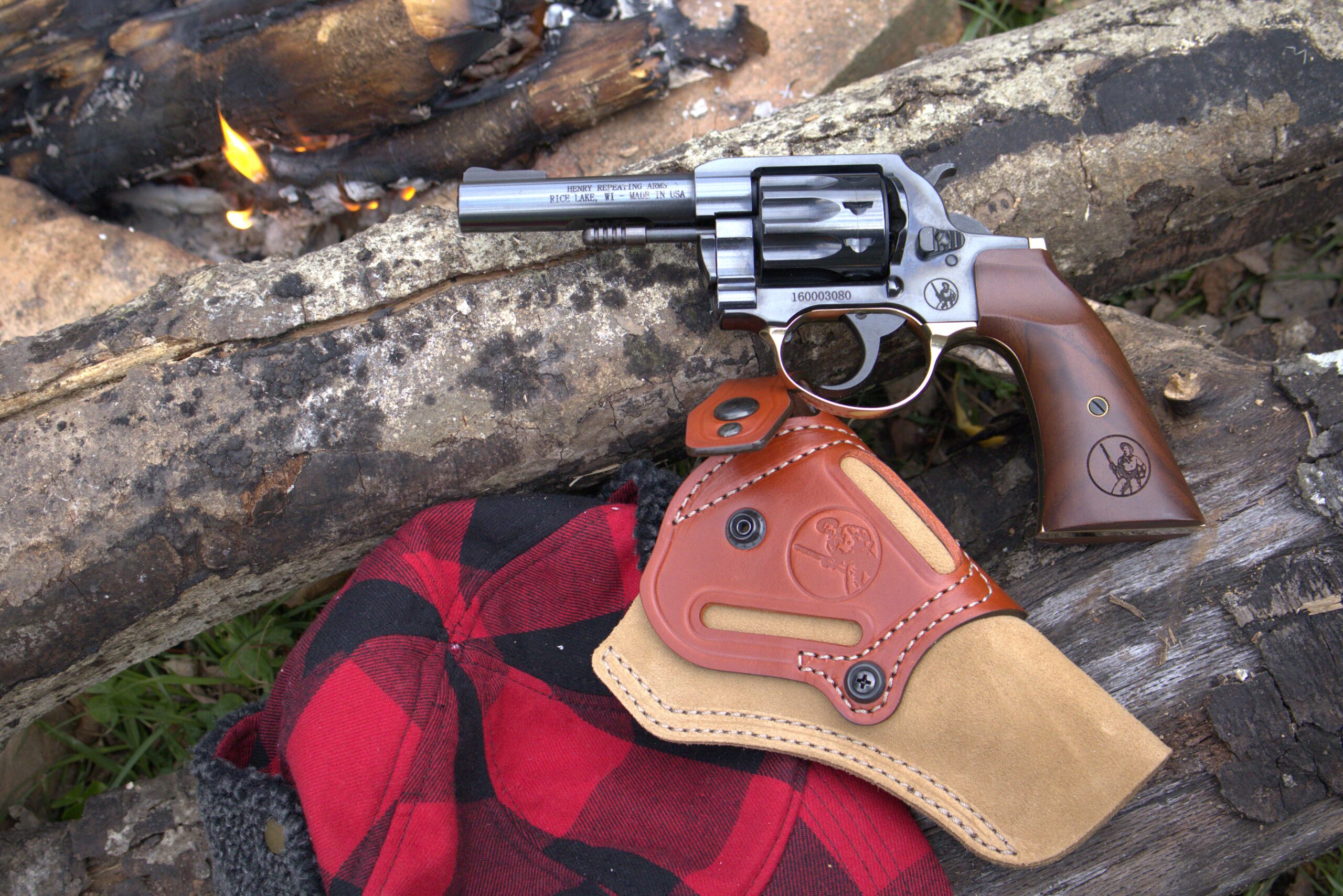
I fully expected a single-action revolver, but what we got was a unique, heavy-barreled, exposed-ejector rod of an old Colt double-action, with the brass grip frame of a Navy Colt, and a dash of Smith & Wesson lockwork thrown in. It was not until the launch of the .22 rimfire version, the Henry Golden Boy revolver, that I was ready to give it a try.
Features
The Henry Golden Boy revolver gets its name from the original Golden Boy rifle .22 caliber rifle that is perhaps Henry’s most recognizable lever action. Like the rifle, the revolver shares its name and its overbuilt character.
Advertisement — Continue Reading Below
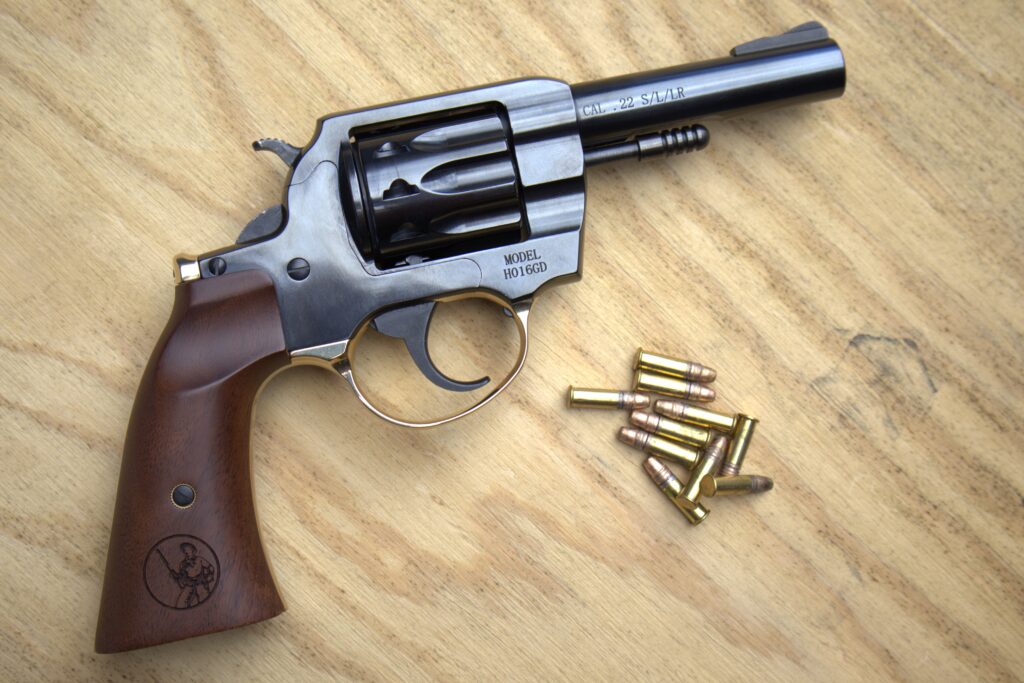
The Golden Boy is built on the same frame as the .357 Magnum Big Boy revolver and about the size of a Smith & Wesson K-frame. But instead of six rounds of .357, you get ten rounds of .22 LR ammunition. The Golden Boy will also chamber shorter .22 Short and .22 Long ammunition. The cylinder is more than long enough to also accommodate .22 ratshot as well.
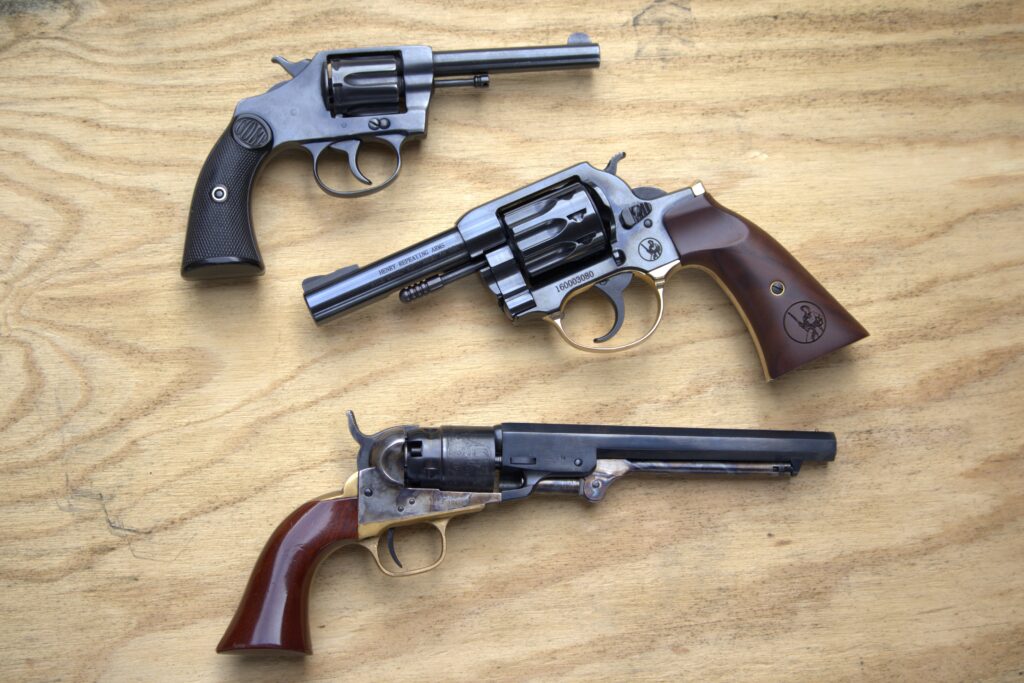
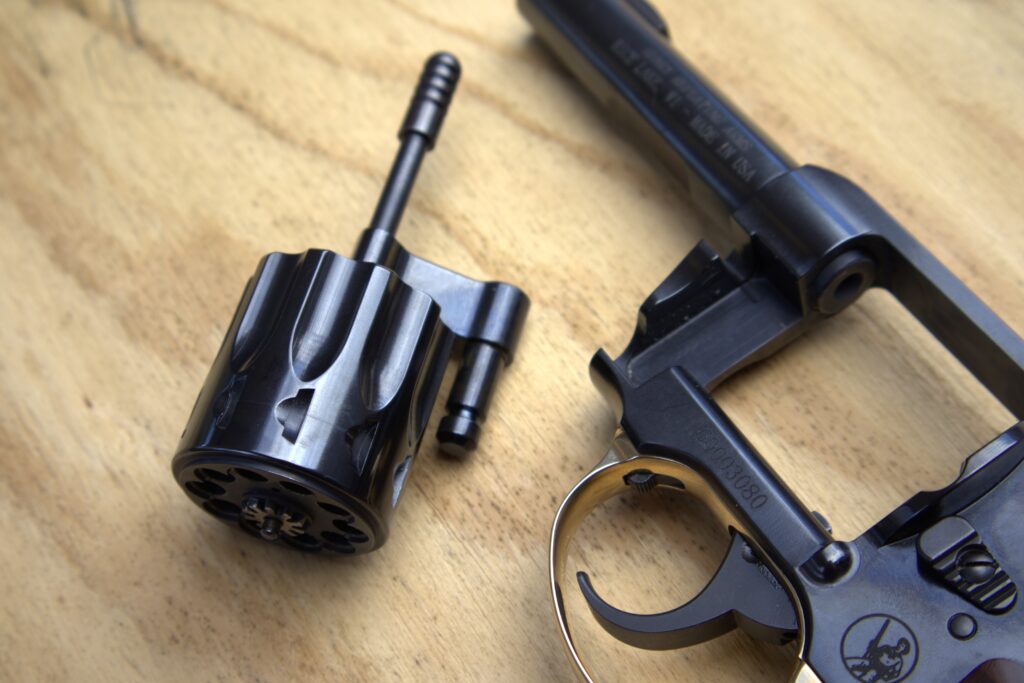
It is a swing-out cylinder revolver with a small cylinder release that is activated by pushing it forward, like on a contemporary Smith & Wesson revolver. The ejector rod hangs in space below a blued 4-inch bull barrel, giving the impression of an old Colt Officer’s match. On an even more interesting note is the fact that the cylinder is removable via a push button on the inside of the triggerguard, a handy takedown feature that is seldom seen.
Advertisement — Continue Reading Below
Another feature seldom seen is the use of either a round butt or square butt brass grip frame that accompanies the smooth walnut stocks. I am accustomed to seeing that on Colt percussion revolvers, but not a modern ten-shooter.
Getting the Golden Boy on Target
The sights are mostly fixed and on the narrow, but higher-profile, side. The rear sight is a groove in the top strap of the blued steel frame, while the front sight is a serrated ramp that can be changed out with a flathead screwdriver bit.
Advertisement — Continue Reading Below
Thankfully, Henry supplies high, medium, and low front sights to adjust the point of impact of the revolver. This is a handy feature for a fixed-sighted revolver, as with .22 rimfire, sometimes the most accurate load does not hit to the sights.
Unique among double-action revolvers today, the Golden Boy comes with the choice of a Gunfighter (plow handle) style grip or a bird’s head grip. The revolver for consideration here is the gunfighter model.
Advertisement — Continue Reading Below
The Henry Golden Boy revolver is a double-action/single-action revolver with an exposed hammer. The hammer may be thumb cocked for a lighter trigger pull, or the revolver can be fired by simply pressing the trigger, which cocks and drops the hammer in one motion.
On the Line with the Henry Golden Boy Revolver
Shooting rimfire pistols has extremely high highs and extreme lows. On the face of it, an all-steel revolver mechanically does away with the problem of .22 rimfire dud rounds or underpowered rounds you are bound to find in bulk pack ammo. That platform should also be the easiest to shoot compared to smaller or lighter options. There are several ten-shot .22 revolvers on the higher-end market, and I have had mixed results. The Henry Golden Boy is not one of them.
Accuracy
Rimfire guns, for some unscientific reason, tend to like certain brands of ammunition over others, regardless of the actual quality of the ammunition itself. The Golden Boy is not immune to this. I started my shooting with the Golden Boy revolver at 25 yards with a variety of ammunition. The results are as follows:
Advertisement — Continue Reading Below
- Eley Target 40 grain LRN: 3.4 inches
- CCI Mini Mag 36 grain HP: 3.2 inches
- Winchester Western 36 grain HP: 3.0 inches
- CCI Stinger 32 grain HP: 2.8 inches
- Federal Punch 29 grain FP: 2.8 inches
- Federal Target 40 grain RN: 1.8 inches
I could reliably put five rounds into a 3-inch group at 25 yards in single action from the bench. Ironically, the most expensive ammunition I had on hand gave me the worst grouping. The Federal Target 40-grain standard velocity load gave the best showing, with consistent groups under 2 inches wide. More than enough for tin cans, small game, and anything else.
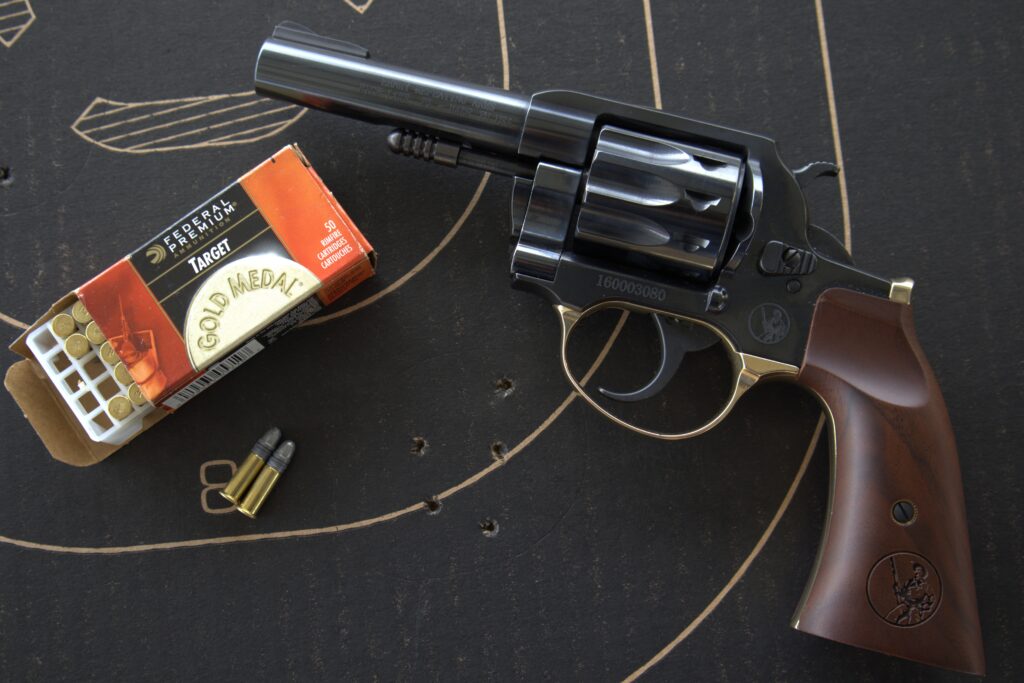
Initially, my groups struck to the right of my aiming point until I realized I was putting too much finger on the trigger. Because the sights on the Golden Boy are fixed for windage, you cannot adjust for side-to-side movement, so they have to be on from the factory. Thankfully, after correcting my trigger press, those Federal rounds hit exactly where I was aiming.
Advertisement — Continue Reading Below
Reliability
Reliability is a cause of concern with rimfire ammunition, but if switching ammunition does not fix the issue, there is a deeper problem. The Henry Golden Boy went through a trouble-free 300-round test. This included single- and double-action shooting out to 50 yards with multiple types of ammunition.
During testing, I shot bulk-pack offerings such as the Winchester Western 36-grain hollow-point load, as well as the Remington Golden Bullet and Federal Automatch 40-grain solid load. I even found and shot up a fifty-round box of greasy Armscor 40 grain rounds. The Golden Boy ate them and ejected the empties without a worry.
Shooting Impressions
In going for accuracy and reliability, I also got a feeling for how the pistol itself is set up as a shooter. That comes down to both its mechanical and aesthetic features.
Advertisement — Continue Reading Below
Mechanically, the Golden Boy is a double-action ten-shooter with a swing-out cylinder. The cylinder latch is pressed forward, and the cylinder is tilted out of the frame to the left for loading. You can load the ammunition one by one or with a speedloader.
I did most of my shooting with loose ammunition, but I also made use of a 10-shot Tuff Strip (like a Bianchi Speed Strip) and a Speedbeez 10-shot loader. The Speedbeez option is quite fast, and the fact that Henry relieved the slick wood grips for a speedloader was a smart move.

Advertisement — Continue Reading Below
With the cylinder full, it is then closed, and you can fire away by pressing the trigger or cocking the hammer and pressing the trigger for a lighter single-action pull weight. In single action, the trigger breaks clean at 4 1/2 lbs. The only gripe is the particularly long reach for the hammer with my shorter thumbs.
I did most of my shooting in double action. Most rimfire revolvers have heavy hammer springs, which makes the trigger pull tougher than their centerfire counterparts. This was not the case with the Golden Boy, as the trigger came in at a respectable 8 lbs. on my scale. Similar to a Smith & Wesson revolver, the double-action pull is hill-like: easy at first, then difficult, then sudden ease before the break.
Taking my time, it was easy to pick up the front sight and ring an eight-inch plate at 50 yards.
Handling the Golden Boy
Once finished shooting, open the cylinder in the same fashion and rap the ejector rod to kick out the empties. The ejector rod is more than long enough to kick out stubby .22 LR empties. The tip of the ejector rod is enlarged and pill-shaped, so you kick out stubborn empties without rubbing the palm of your hand. That is a useful feature as, toward the end of my test, the revolver got harder to unload as residue was starting to build up in the cylinder.
The Gunfighter grip provides a secure full-hand grip, and the bull barrel achieves perfect pointable balance. I can see the slick grips being an issue with hanging onto the pistol if it were a centerfire. However, it is not an issue with the Golden Boy and the recoiless .22 LR cartridge.
If I had to pick a weak spot in the Henry Golden Boy, it would lie in the sights. The inclusion of various front sights is a smart move to make sure the fixed sights hit where your favorite load prints. It also helps that Henry did a great job of making sure the sights come regulated for windage at the factory. But unlike other pistols in this genre, the Golden Boy’s sights are low profile and have no windage adjustments, should they be needed.
I would not be surprised if, at some point, Henry comes out with a target version of the Golden Boy that strengthens its already solid armor. But on the whole, the stock sights don’t block small targets like more adjustable options would, and they certainly cannot be knocked out of alignment.
The Bottom Line
It is passe to say that we should not judge a book by its cover. The Henry Golden Boy revolver is certainly proof of that maxim. On first seeing it, I did not know what the design team was going for. If anything, I expected an all-steel single-action from Henry as a first revolver line.
But, on reflection, the Golden Boy makes sense. You get brass and blued steel accents to match your existing Henry rifle, and a ten-shot double-action pistol better matches what you have on tap with a tube-fed .22 rifle.
On its own merits, the Golden Boy .22 may not be the best setup for bullseye work, but it excels at what the lion’s share of us will use a .22 pistol for. Whether you have one on the belt for popping small game for the pot or enjoying a crisp off-season day on the firing line, the Golden Boy is capable in spades.