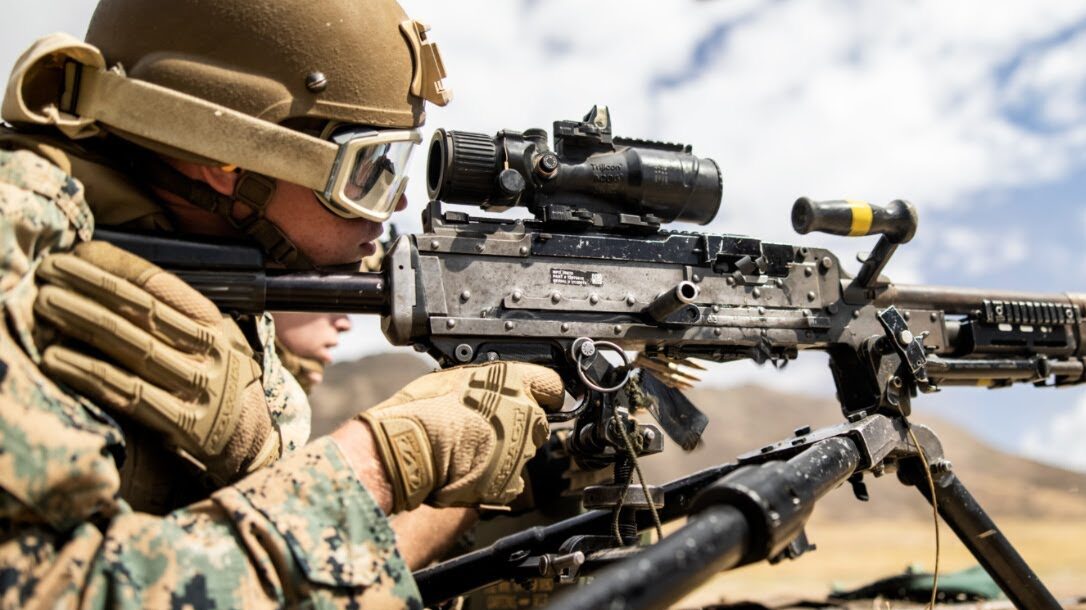
A machine gun has two current definitions. We have the legal definition, which applies to any gun that fires more than one round per trigger pull. This applies to any full-auto firearm, from handguns and rifles to belt-fed machine guns.
The military definition is a fully-automatic firearm designed for sustained direct fire. The military definition typically results in belt-fed guns ranging from 5.56 to 30mm machine gun grenade launchers.
Where Did the Term “Machine Gun” Come From?
The definition of what a machine is has changed over the years. The term did not start by describing weapons that fired more than one round by the press of a trigger. It’s evolved to that current definition, but as someone who is enamored with machine guns, I am a machine gunner by trade, and I want to examine the evolution of the term.
Advertisement — Continue Reading Below
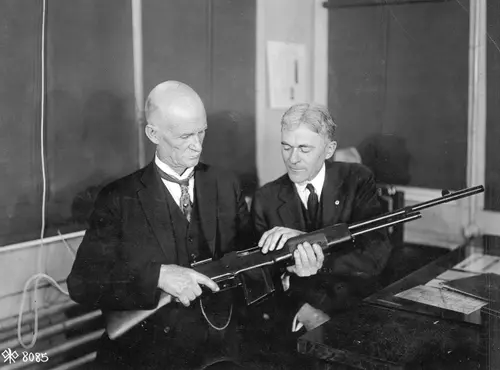
I’ve been reading a series written by U.S. Marine Corps Colonel George M. Chinn titled The Machine Gun. It’s a five-volume series that covers just about anything and everything in regard to the history of machine guns. It clocks in at over half a million words.
The Machine Gun Birth
Ever since the first man put a ball of metal behind a gunpowder charge, they aimed to make them more effective. More effective typically meant that the most shots could be fired by the fewest soldiers. This led to the development of organ guns and volley guns, which were multi-barrel firearms that fired all barrels simultaneously. These heavy guns were often mounted on wheels and intended for use in a semi-fixed position.
Advertisement — Continue Reading Below
The Kalthoff repeater in 1630 was the first to be fielded by a military force. These were lever-action guns with a variety of designs. However, they fed from magazines. One held balls and the other powder. When the lever was activated, the ball and powder were dropped into the barrel, and the gun primarily used flintlocks with some wheellock designs.
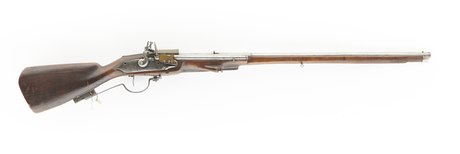
While it was ahead of its time, it was difficult and expensive to produce. The complicated action requires gears, and if they broke, the gun became unusable. Overall, it couldn’t replace the traditional muzzle loader.
Advertisement — Continue Reading Below
From there, repeating firearms were largely experimental, but we began to see machinery in their operation. No one described these guns as machine guns, but there was some machinery at play. Colt would later create a ring lever revolving rifle, which was the first repeating firearm adopted by the U.S. military and used in the Seminole War.
Arguably, these weapons use machinery. They use the energy from manual operation to function. They weren’t called machine guns, but the idea of using machinery with firearms was quickly taking hold.
The First Machine Gun
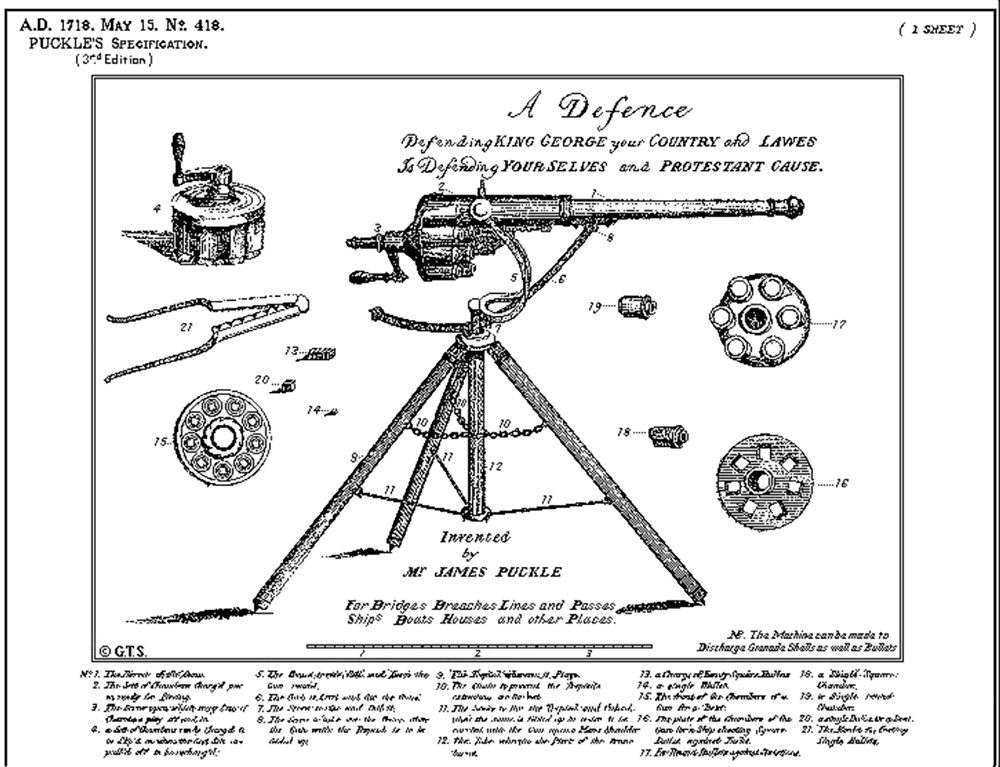
In the 1700s, before the Colt Ring Lever, there were numerous attempts to create repeating cannons. The most notable is the Puckle Gun. The Puckle Gun was basically a massive manually operated revolver that fired 32mm projectiles from a cylinder that held six to eleven rounds.
Advertisement — Continue Reading Below
The cylinders could be removed and swapped to keep the gun firing. Puckle designed the gun to fire round bullets for fighting Christians and square bullets for fighting Turks. The square bullets were thought to cause more pain.
This seems to be the earliest known gun referred to as a machine gun. The creator called it a portable gun or machine that discharges so often and so many bullets, and can be so quickly reloaded as to render it next to impossible to carry any ship by boarding.
Advertisement — Continue Reading Below
The Puckle gun was referred to as “2 Machine Guns of Puckles” on a ship’s manifest from 1722, according to The Armoury of His Grace the Duke of Buccleuch and Queensberry by Paul Wilcock.
Throughout the 1700 and 1800s, we saw massive amounts of multi-shot cannons come into existence. None were very successful, and most were built in small numbers. Historical records are scant, but French, German, Dutch, and English inventors were all making their version of the “machine gun.”
Most were multi-barrel firearms that were often designed to be quick to reload. Most fit the definition of crew served, requiring a crew of soldiers to operate, but some promised that a single man could operate the gun. These guns all had the same issues as the Kalthoff repeater. They were expensive, difficult to manufacture, and easily broken.
Advertisement — Continue Reading Below
Into the Future
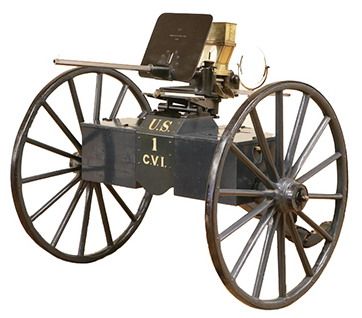
The American Civil War introduced several concepts to the battlefield. This included lever-action rifles, metallic cartridges, and early machine guns. In 1861, Wilson Agar introduced the Agar gun, which became known as the Coffee Mill Gun. Agar described his gun as “an army in six feet square” due to its rate of fire.
The Agar gun used paper cartridges loaded into reusable metal tubes fit with a percussion cap on a nipple. It’s the most roundabout way of making metallic cartridges. Soldiers loaded these tubes into a funnel-shaped hopper and then used a hand crank that would load the gun from the hopper and fire them one by one.
Advertisement — Continue Reading Below
The gun would eject the empty tubes into a container below the gun so they could be reloaded and reused. This gun required a crew to load and fire. It was known to overheat, but adapted to have a quick replace barrel, much like a modern machine gun. There was also a metal jacket fit to the barrel to provide air cooling through a turbine that was connected to the firing crank.
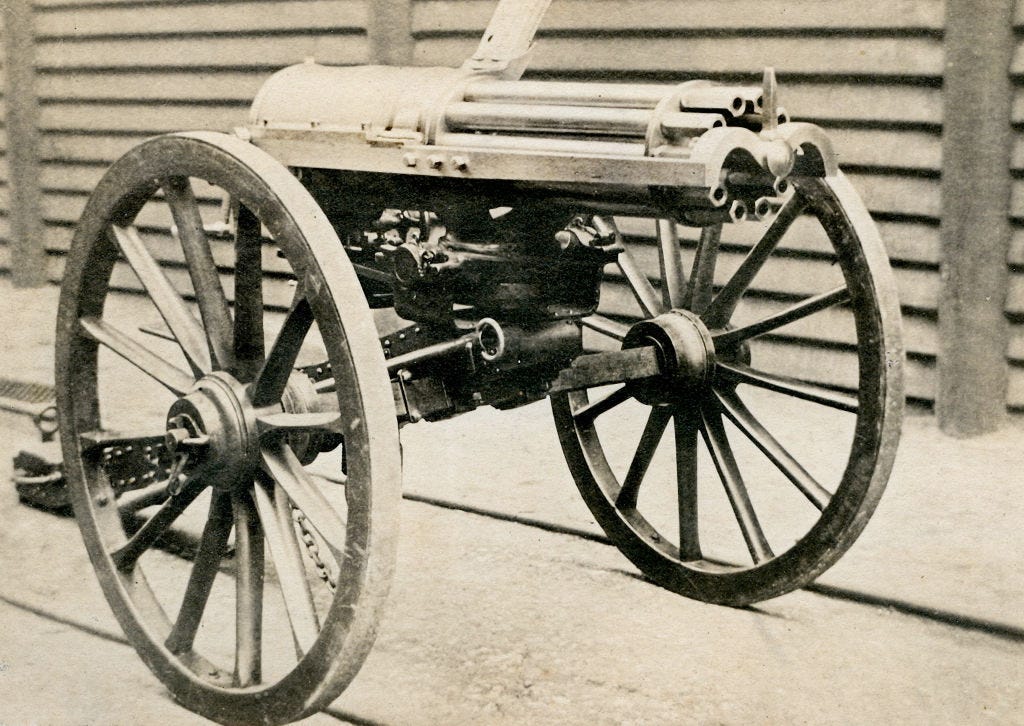
In 1861, we saw the patent for the Gatling gun, arguably the most machine-gun-like of the options to date. The Gatling gun used multiple rotating barrels and fed from a top-mounted hopper that originally used self-contained paper cartridges. Later models would utilize brass-cased ammunition.
Advertisement — Continue Reading Below
The multiple barrels solved the overheating problem, and the Gatling gun was a massive success. It was seen as reliable, and the gun was adopted all over the world. Richard Gatling designed it with the idea to reduce the size of armies and, therefore, reduce the number of deaths on the battlefield.
World War I and Beyond
Hiram Maxim created the first self-powered machine gun in 1884. The Maxim machine gun used a recoil operation to create a truly full-auto firearm. The Maxim gun would arm the world and see extensive use in World War I, with both sides of the Great War.
While World War I introduced machine guns to mass warfare, it wasn’t the first time they were used in combat. Numerous small engagements around the world saw the machine gun employed. In 1898, the Marine Corps wielded the M1895 in the Spanish-American War.
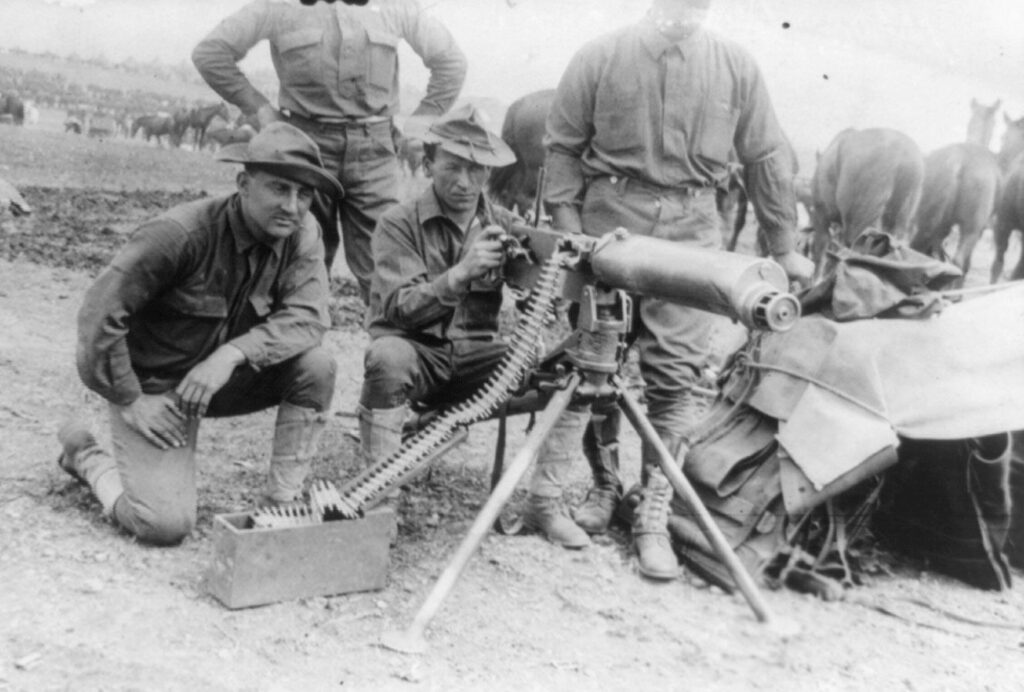
There, they used machine guns to lay down covering fire to support an assault, marking the first known instance in history of their use to support an infantry assault.
After the Maxim entered the world, the definition of machine gun changed. This led to the definitions we have today. Machine guns are full-auto firearms designed to provide sustained fire.
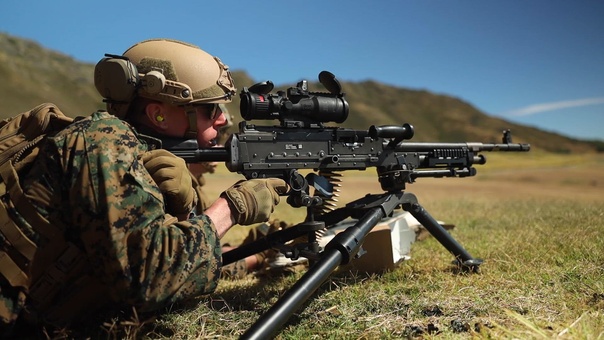
The evolution of the term is fascinating. Guns like the Gatling aren’t considered machine guns legally, and you can own a Gatling gun without any NFA paperwork. However, they formed the basis of the first machine guns and drove the development of weapons that fired faster, were smaller, and carved out their own place on the battlefield.
To learn more, read part 1.