Newton’s Third Law of Motion says: “For every action, there is an equal and opposite reaction.” He didn’t have firearm recoil—the backward push of a gun when a cartridge is fired—in mind when he developed the theory, but he certainly could have. For some, recoil can be a deterrent to entering the shooting sports. So, let’s talk about taming recoil so your next range trip is an enjoyable one.
Tips for Taming Recoil
One of the most challenging things for new shooters is to fire without letting the natural recoil of the firearm affect them. The reason it is important is that it becomes nearly impossible to shoot accurately if shooters anticipate the recoil and flinch or move to compensate for it when squeezing the trigger.
Advertisement — Continue Reading Below
Instead of digging into the science of recoil, let’s look at a few strategies for taming recoil in both long guns and handguns.
Rifle Recoil
First, pull the butt tight to your shoulder. If you leave any gap between your shoulder and the butt of your rifle, you’ll experience a lot more felt recoil when you pull the trigger. Pull the butt in tight to your shoulder and lean into it before firing.
Having a good grasp on your rifle, both at the grip and the forearm, can help reduce felt recoil, too. That’s because you are absorbing some of the backward force with your hands, wrists, and arms.
Advertisement — Continue Reading Below
Always get a good rest or stance. If standing, a proper forward-leaning stance will allow your lower body to help absorb some of the force. If shooting from a rest, try to get in a perfect position where the stock is pushed tight against your shoulder. Shooting from odd positions—especially leaning backward—always makes it feel like a gun is kicking harder
Choosing the right gun/ammo combination can also help. To reduce recoil, use heavier rifles with smaller bullets fired at lower velocities. That’s not always practical for hunting, but at the range, it can make all the difference. For the very recoil sensitive, getting some reps at the range with a heavy .22 can help build good form that will help with recoil when moving back to a centerfire rifle.
Lastly, practice until you are comfortable with the recoil. When you first start, the recoil can be quite startling. But the longer you shoot your gun, the more accustomed you become to it. Shoot your rifle frequently, and the recoil will soon become just a part of your fun shooting experience.
Advertisement — Continue Reading Below
Pistol Recoil
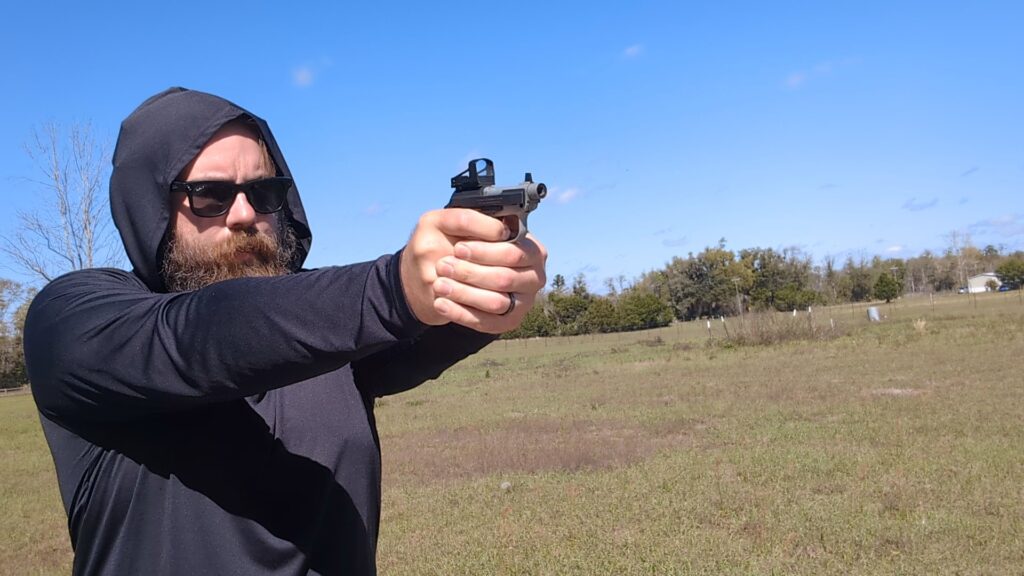
As with taming rifle recoil, setting up in a good, solid stance is the first key to managing recoil in handguns. Stand with your feet side by side, a little wider than your shoulder width, and your chest squared to the target. That will give you a solid base. The arms should extend to nearly full extension, and the area between your shoulders and your gun should look somewhat like a long “V.”
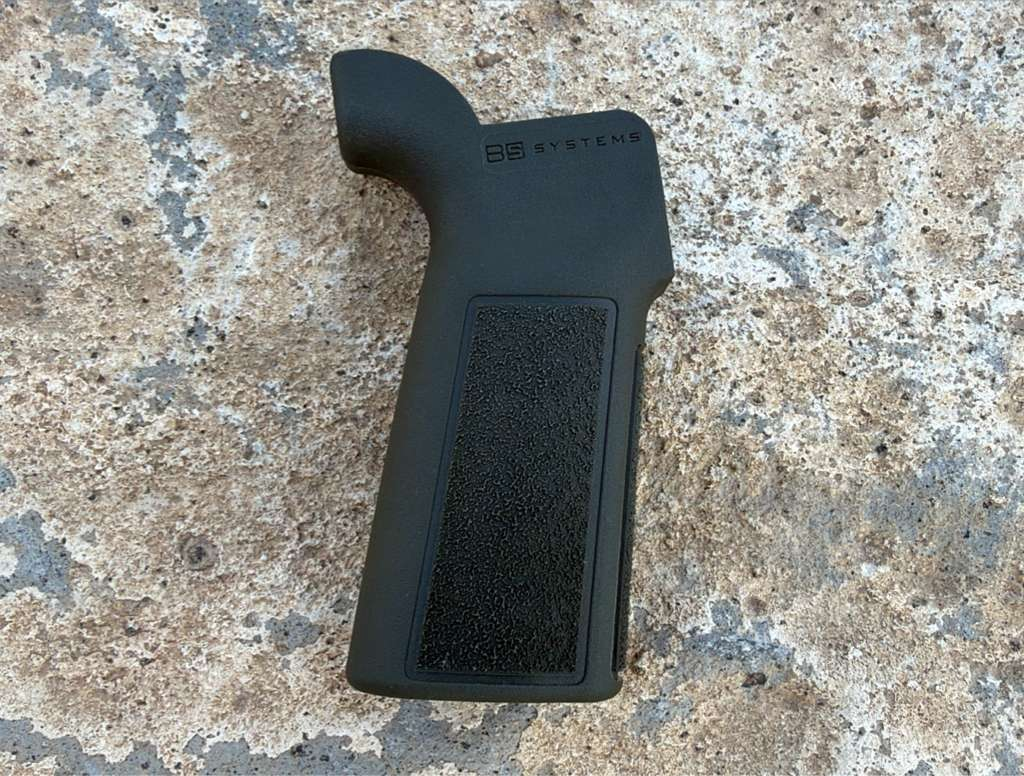
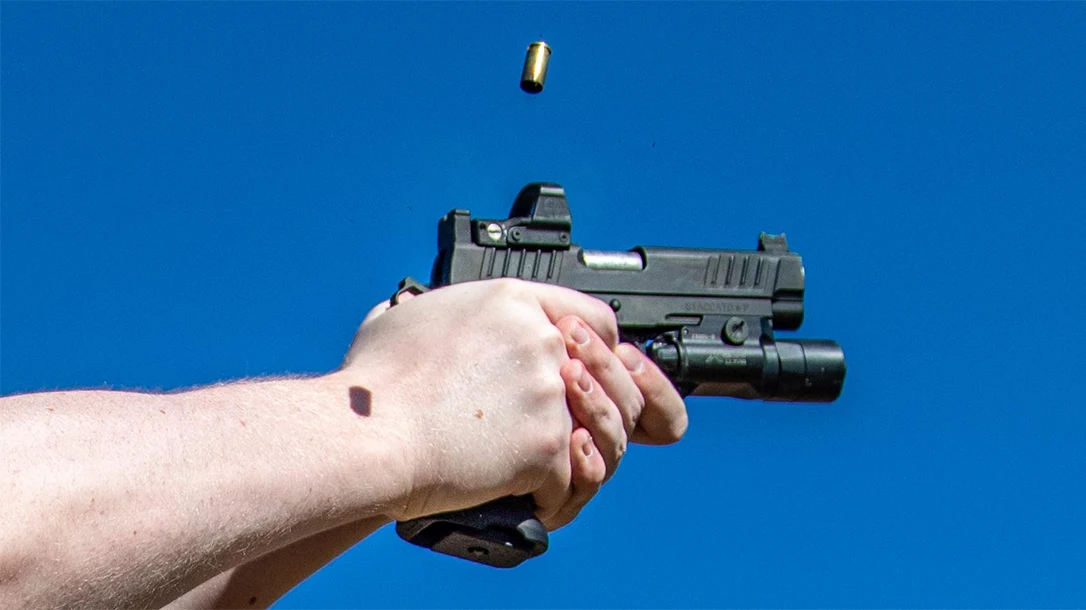
Building a good grip is the next most important thing, and not everyone agrees on the best way to do this. One that works for me is to start with your strong hand (gun hand) as high up the grip and into the backstrap as you can. Once you have the strong hand in place and your fingers wrapped around the grip except for the trigger finger, mate your weak hand into the open space on the side of the gun’s grip that your strong hand left uncovered.
Now that you have your stance and grip, concentrate on the grip, target, and squeeze. Thinking about the upcoming recoil and muzzle blast causes many shooters to flinch or jerk. I’ve found the best way to avoid that is to concentrate completely on keeping a perfect grip, keeping the sights on the target where I want the shot to hit, and making a straight, slow squeeze on the trigger.
Advertisement — Continue Reading Below
Ultimately, recoil is just a fact of life, so you might as well embrace it. Practice shooting often enough with a good stance, grip, and squeeze, and soon the recoil won’t be as apparent as it once was. Trust me, you’re not going to change the laws of physics. So, it’s better to accept them for what they are and mitigate them by firing lots of rounds often.