While many new gun owners aren’t aware of this fact, many people use their firearms—whether handgun, rifle or shotgun—for various types of competition. These competitions allow shooters to constantly improve while also enjoying camaraderie with like-minded individuals.
What to Expect From Shotgun Competitions
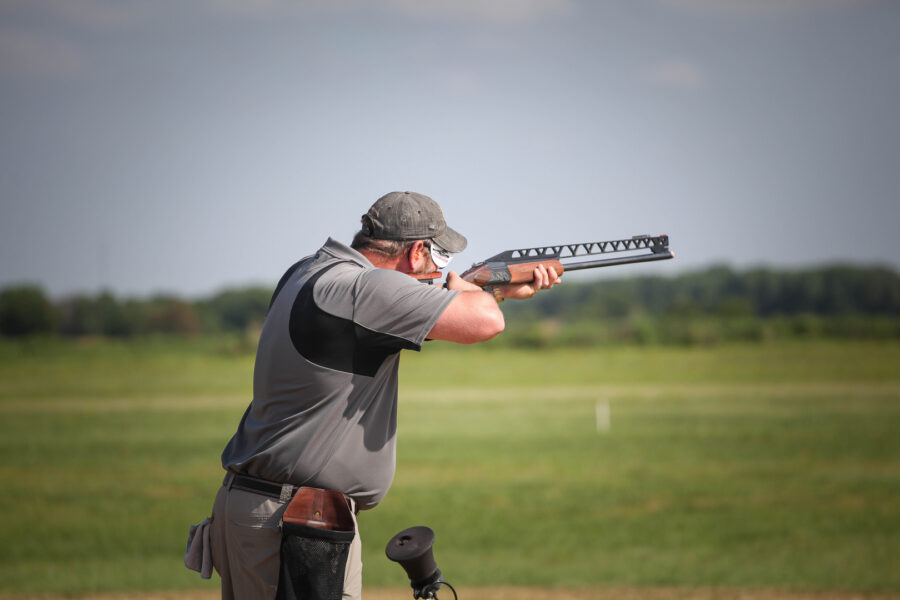
For shotgunning, the three main types of competition are skeet, trap, and sporting clays. All three involve shooting clay birds, and all three are a ton of fun in their own way. Here, I’ll give a brief rundown of all three shotgun sports for those who might want to give one or more a try.
Skeet
Skeet offers fast-paced action and challenging shooting. Americans have been playing this game since the 1920s, and the World Skeet Championship is held in San Antonio, Texas, every year.
Advertisement — Continue Reading Below
The game of skeet uses two trap houses—a high house on the left side of the field and a low house on the right. Shooters move through eight shooting stations, seven of them arranged in a half-moon between the two houses and one directly between them.
A round of skeet consists of 25 targets, with 17 shot as singles and eight as doubles. The first miss is repeated immediately and is called an option. If no targets are missed during the round, the last, or 25th target, is shot at the last station, low house 8.
At stations 1 and 2, shooters shoot a high-house single, a low-house single, and a high-house/low-house pair launched simultaneously. At stations 3, 4, and 5, shooters fire at a high-house single and a low-house single. Stations 6 and 7 are similar to 1 and 2 with a high-house single, a low-house single, and a low-house/high-house pair. Station 8 consists of a high-house single and a low-house single.
Advertisement — Continue Reading Below
Skeet requires a lot of finesse and hand-eye coordination, since the targets are all crossing shots. Hitting them requires a different amount of “lead” depending on the range and the angle. Skeet has categories for all the gauges, including the diminutive .410 bore.
Trap
According to reports from a publication called Sporting Magazine, by the year 1793, trap shooting was well established in England. The first recorded organized trap shooting in the United States is thought to have been held at the Sportsman’s Club of Cincinnati in 1831.
While there are different variations of the game, here we’ll concentrate on American Trap. In this game, targets are thrown from a single “house” forward of the shooters’ position. Shooters shoot from five stations located 16 yards behind the trap house.
Advertisement — Continue Reading Below
In singles, shooters shoot at five targets from each station, with a round consisting of 25 targets. In doubles, the machine throws two clays simultaneously for a total of 10 targets per station. Another variation, handicap trap, is similar to singles, but shooters stand farther back from the trap house.
For shotgunners, trap is a fun game to play. While many shoot trap for practice for upcoming hunting seasons, others fully embrace the sport for what it is and shoot both recreationally and competitively.
Most serious trap shooters use 12-gauge shotguns because of the old thought that more lead in the air is more likely to break the targets.
Advertisement — Continue Reading Below
Sporting Clays
Using clay targets like skeet and trap is much different than either of those disciplines. It is the newest of the three shotgun games, and was sometimes called “golf with a shotgun” when it came on the American scene in the early 1980s.
Sporting clays isn’t shot on a field with trap houses like skeet and trap. Instead, it is typically shot in squads of two to six people and over a course of 10 to 15 shooting stations laid around fields or around the natural features of the land.
While the typical clay target is the same as those used in skeet and trap, sporting clays also uses specialty targets to introduce the illusion of speed or distance in the eye of the shooter, moving at speeds or in the way game birds would. Many courses even have a “rabbit” target bounding along the ground.
Advertisement — Continue Reading Below
Squads begin at the first station and work around the course from station to station in numerical order. Before the first person in every squad shoots, targets will be launched to familiarize the squad with what targets are being thrown and the direction in which they’ll fly, so shooters can form a strategy for shooting the targets at that station.
Since target setters can craft the course just about any way they want, you just don’t know what to expect until you get to any station and watch the first bird thrown.
A round is complete when all shooters have shot all stations—typically 100 rounds of ammo. Sporting clays is largely shot with 12-gauge shotguns.
Advertisement — Continue Reading Below
Wrapping It Up
All three of these shotgunning disciplines are a lot of fun, and there’s a good chance a range near you features at least one, if not more. Give it a try. You’ll make new friends and maybe even find a lifelong hobby.