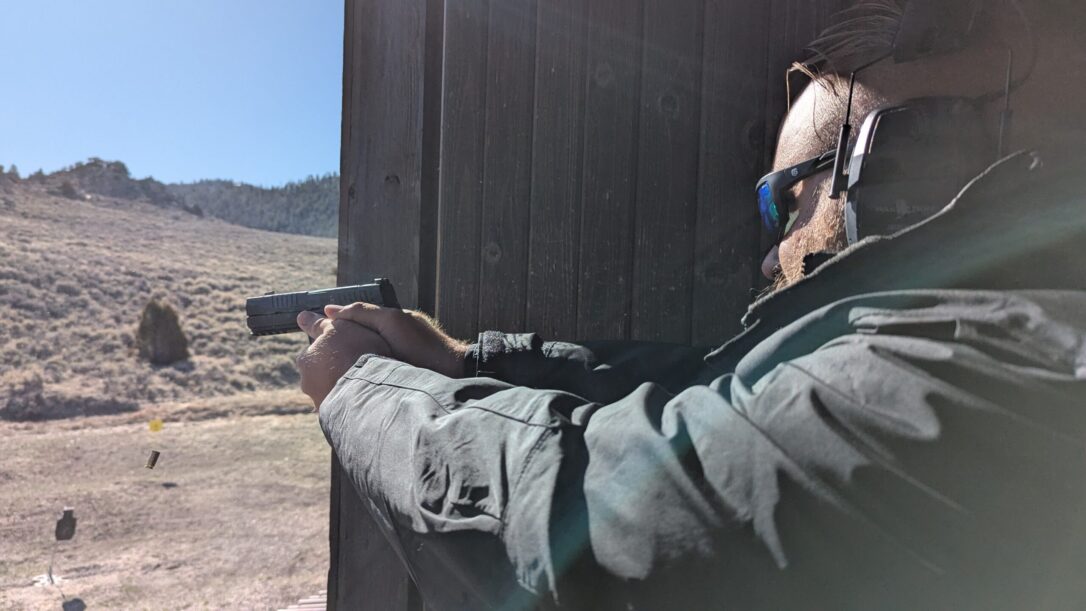
Sometimes I get to thinking that the firearms world moves past certain old ideas. Things like birdshot for home defense, “Dutch loading” FMJs and JHPs, and point shooting. Yet, every time I’m proven wrong. Most recently, point shooting has graced my feed in more than one way. How this idea of shooting without aiming sticks around is beyond me.
Is Point Shooting Still Valid?
Point shooting comes from the idea that you won’t see your sights in a gunfight. There was a time when this was partially true. Look at the sights on pistols of yesteryear—guns like the original 1911, the Colt M1903, and basically every gun of that era. The sights are extremely small and difficult to use.
Advertisement — Continue Reading Below
Men like Jelly Bryce had a freakish ability to shoot from the hip and hit their target. We can’t deny that talent, but we have to admit that’s a once-in-a-generation talent. We aren’t Jelly Bryce.
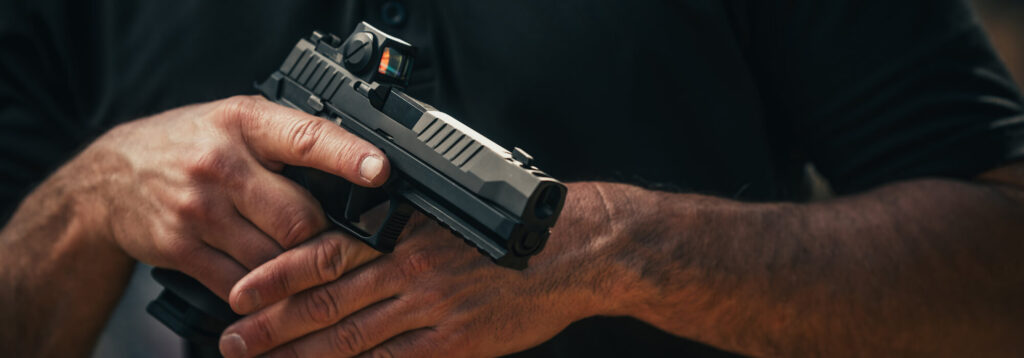
In the modern era, sights are massive, easy to see, and available in a variety of configurations. Let’s not forget the dominance of red dots in the modern era. There isn’t an excuse for you not to be able to see your sights in the modern era. Yet point shooting persists.
Let’s Define Point Shooting
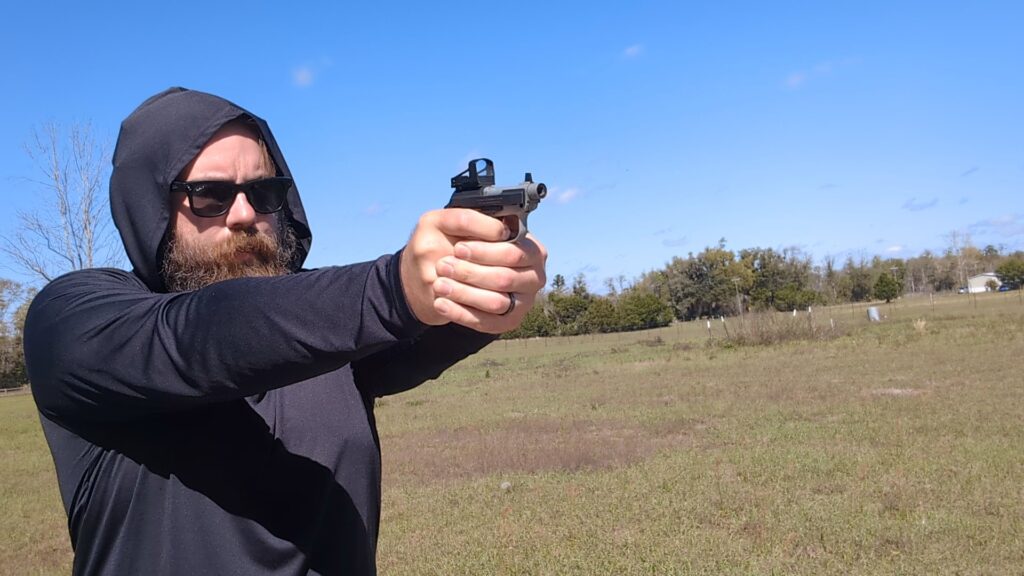
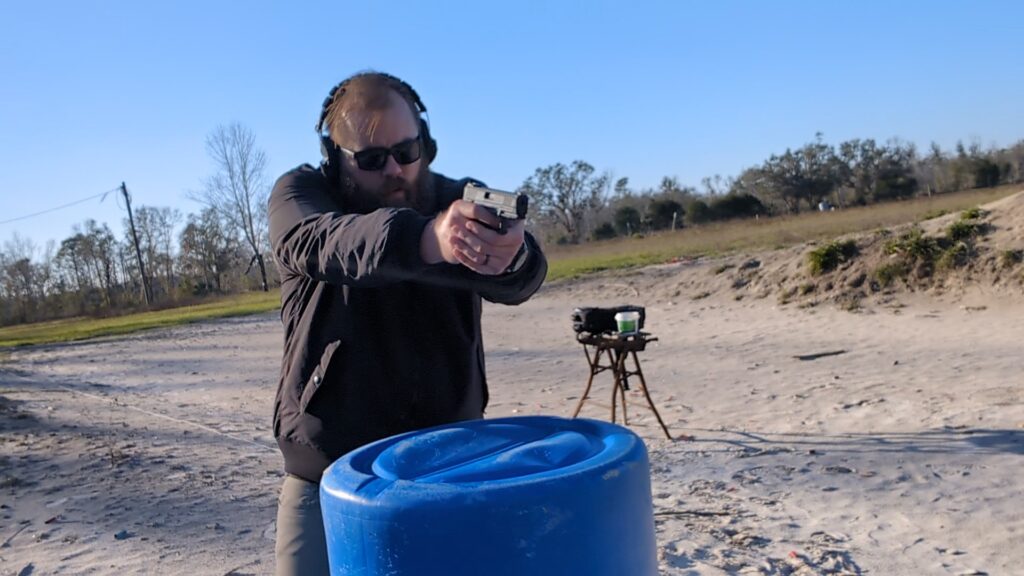
When I say point shooting, I mean shooting from a position that does not allow you to use your sights. If you are coming to full extension with your head behind the gun, you aren’t point shooting by my definition. You’re using the entire gun as a sight.
Advertisement — Continue Reading Below
You’re still aiming, but you’re doing it in a different way. We might not be using the sights, but you’re using the gun to aim. At close ranges, this is a valid technique. If a bad guy is super close, you don’t need a 3 MOA dot to hit the target. The outline of the gun works.
However, as the range increases, this technique becomes increasingly difficult to use.
Where Point Shooting Makes Sense
Where point shooting does make sense is any time you are in a close retention position. You’re tucking that gun just in front of the body and firing at a threat that’s extremely close. It’s scenarios where missing is difficult, and the enemy is so close you can’t extend your arms enough to aim.
Advertisement — Continue Reading Below
Close retention shooting is the only place where point shooting makes any form of sense. Unless your gun just doesn’t have sights. That’s rare, but the Seecamp series exists, and you can’t do anything but kind of guess while shooting one of those bad boys.
What Point Shooting Advocates Get Right
What point shooting advocates get right is the idea of the human mind being focused on the threat. Under stress, we aren’t likely to stop looking or focusing on a threat to our lives. That’s true, but the issue I see with point shooting advocates is that their knowledge of using sights hasn’t advanced to the modern world.
Advertisement — Continue Reading Below
Red dots make this extremely easy to accomplish. Look through the optic, dot is on target. You’re meant to focus on the threat or target with a red dot.
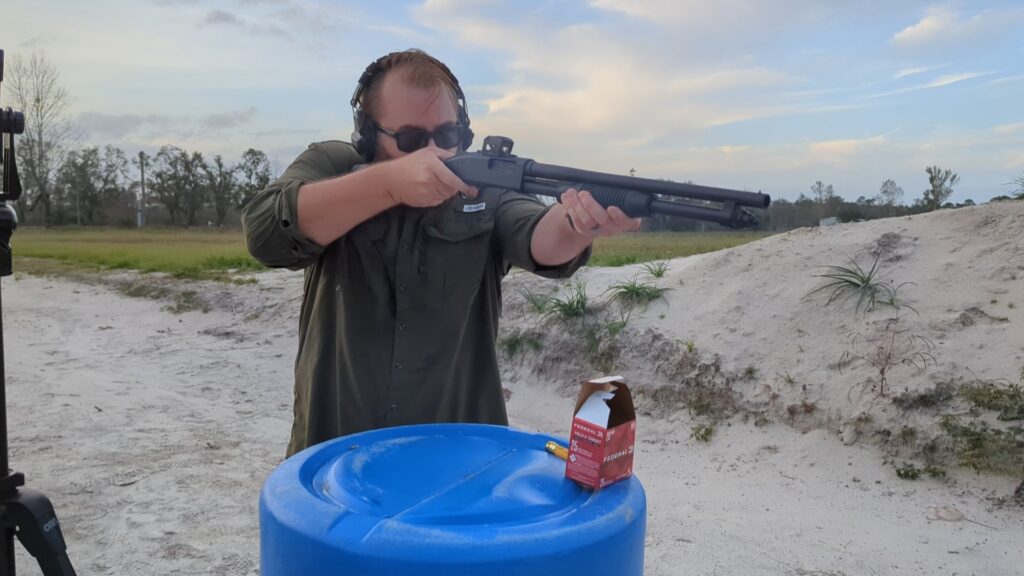
With iron sights, we use the “stress sight picture” mentality. We are putting the sights on the target, with our main focus on the target. The sight, specifically the front sight, will appear to be a bit blurry, but it’s still on the target, and we are still using it.
Advertisement — Continue Reading Below
The old adage of “front sight focus” is really great for taking long-range shots or producing tight groups. For a combat situation, we have some slack, and knowing that we’ll focus on the threat with a blurry sight in our view.
But I’m Good at Point Shooting!
Let’s say you practice to get fast without using sights. Well, great, but your skill relies on proprioception, which is your brain’s sense of where your body is in that space. There are two problems here.
If anything changes, your proprioception can change. If you’re wearing a heavy jacket, your point of aim changes. It can be affected by fatigue, clothing, odd positions, and other unpredictable elements.
Advertisement — Continue Reading Below
Sights are a mechanical constant. It doesn’t matter what you’re wearing, how tired you are, or what stance you’re in. Sights are sights.
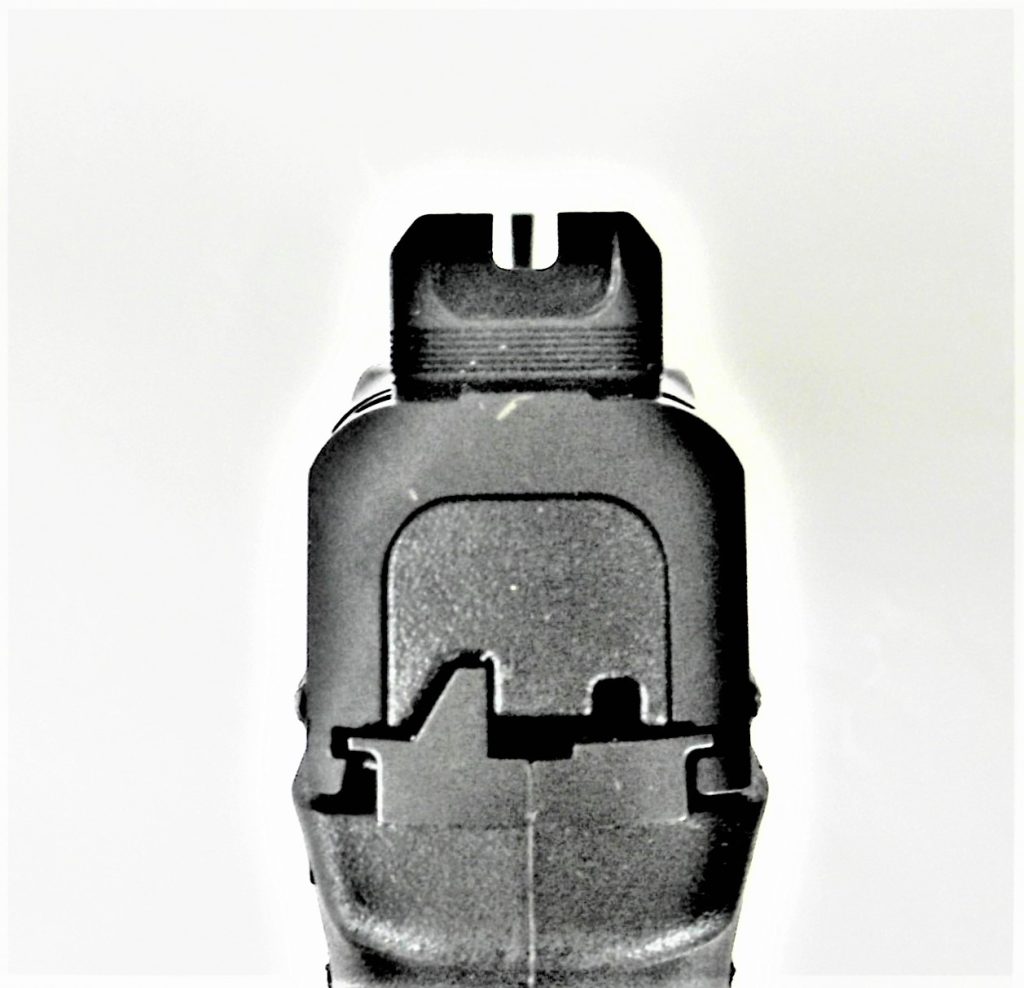
A common defense of point shooting is that we use proprioception daily to great success. I can put a fork in my mouth, I can touch my nose, etc. You can do that tired, with a parka on, and so on and so forth.
Advertisement — Continue Reading Below
Yep, that’s true, because you have a fixed physiological point on your own body. You’re pointing a gun with a muzzle, and you don’t have a fixed index on your body to focus with. A one-degree difference is a six-inch miss at seven yards.
You’re also dealing with a threat that might be behind cover or moving; trying to point shoot a moving target or a small target becomes extremely difficult. Using your sights is much easier in these scenarios.
It’s Not Faster
That’s the biggest claim: it’s faster than sighted fire. That’s true if you suck. If you cannot make acquiring your sights and tracking your sights a skill, then you don’t need to practice point shooting. You just need to practice shooting.
Advertisement — Continue Reading Below
Someone dedicated to half an hour a day of training for a week can learn to draw and get a shot on target very quickly. Shooting an aimed shot on target in less than a second from concealment is not out of the realm of possibility for anyone dedicated to dry fire. I recently accomplished it with a level 3 Safariland rig, but don’t ask me to do that consistently and without a warm-up.
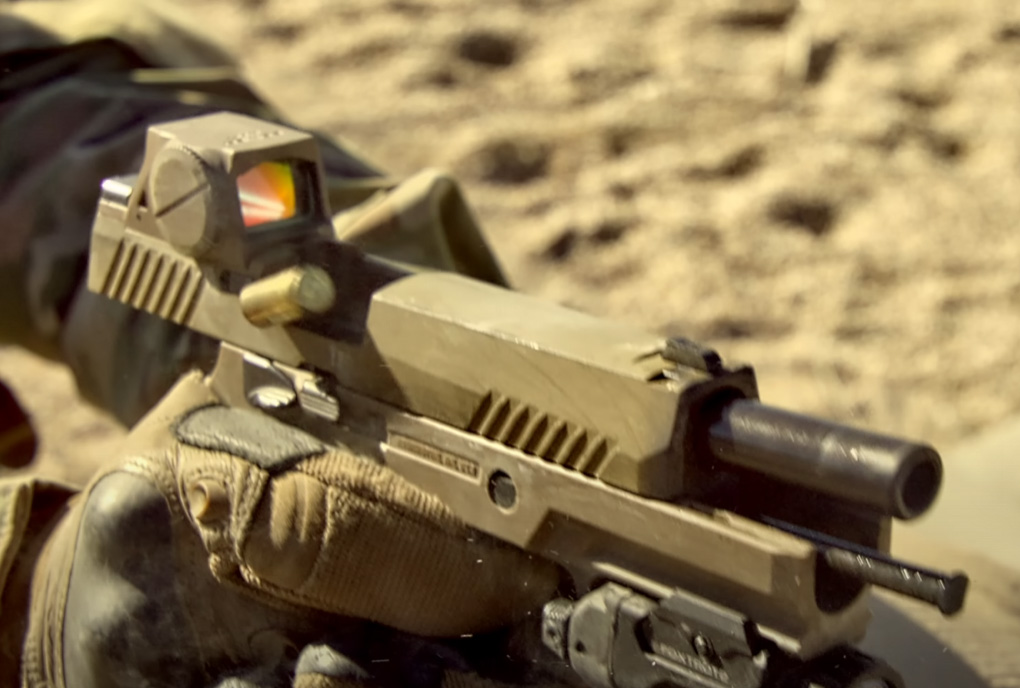
The idea that time is wasted finding the sights only applies to shooters who aren’t training or trained. With enough training, using my sights is not a separate step in getting a shot on target. Aiming with my sights becomes a parallel process, not a serial process.
Let’s say it is faster, for the sake of argument. A point shooting enthusiast can accomplish a fast draw to first shot, but is that shot more likely or less likely to hit the target? And if it hits the target, is it more or less likely to hit something vital?
The speed of the shot is important, but the speed of ending the situation is more important. How much time does an ineffective shot to a threat add to making an effective shot? We must address recoil recovery and reacquire the target.
If the goal is to end the threat as quickly as possible, an aimed shot to the upper torso or head is more likely to achieve this. That can be done quickly and efficiently with training.
Let’s not forget that missed shots can turn into unintentional casualties, regardless of how fast they are fired.
Feedback and Decay
When you point shoot, you are guessing where your round will go. It’s an educated guess, but you get zero feedback. You’re at best walking your rounds like you’re shooting a machine gun. You’re trying to feel your way to the target with point shooting.
When I fire a shot with my sights, I can see the last location of my sight before I pull the trigger. I have an idea of where it’s going, and that idea is always pretty damn close based on my sight picture.
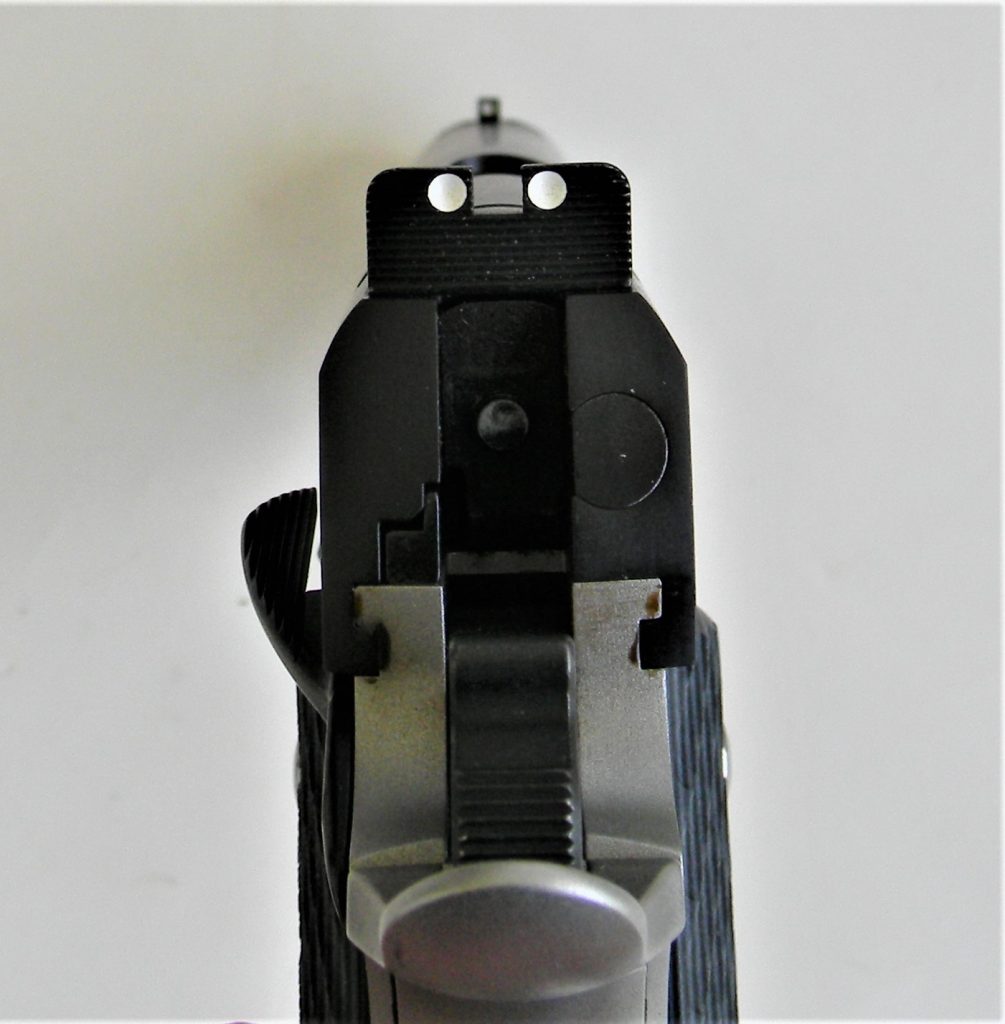
Sighted shooting allows you to shoot at a variety of ranges. Point shooting becomes a massive hazard as the range extends. If you’re off a little at 3 yards, you will probably still hit the torso while point shooting. Extend that range to 10 yards, and you’re way off. The decay over range makes it a tactic that’s only usable at extreme close range, like from a close retention position.
Now, you might throw the “three shots at three feet in three seconds” stat at me. That’s the average, but average doesn’t tell the whole story. The “Flaw of Averages” comes into effect because averages don’t tell the whole story.
If you’re preparing for the easiest possible scenario, what happens when the averages aren’t in your favor? A sighted shooter can be effective at a wide variety of ranges, so long as they can extend their firearm into position.
But You Won’t See Your Sights
Any violent situation will lead to a massive dump of adrenaline and fear. That’s true. Does it make things harder to do? If you haven’t trained for that situation, then yes, it is more difficult. Your cognitive load becomes overwhelmed, and things become difficult to do. This is why training is valuable.
If I put you in a house fire and said put it out, could you? If I did the same to a firefighter, we’d see different results, right? That’s because of training.
If your cognitive load is so overwhelmed that you can’t possibly use your iron sights, then how do you think your point shooting skills will work? If you can take the time to train your ‘point’ shooting, that time is better spent learning to aim.
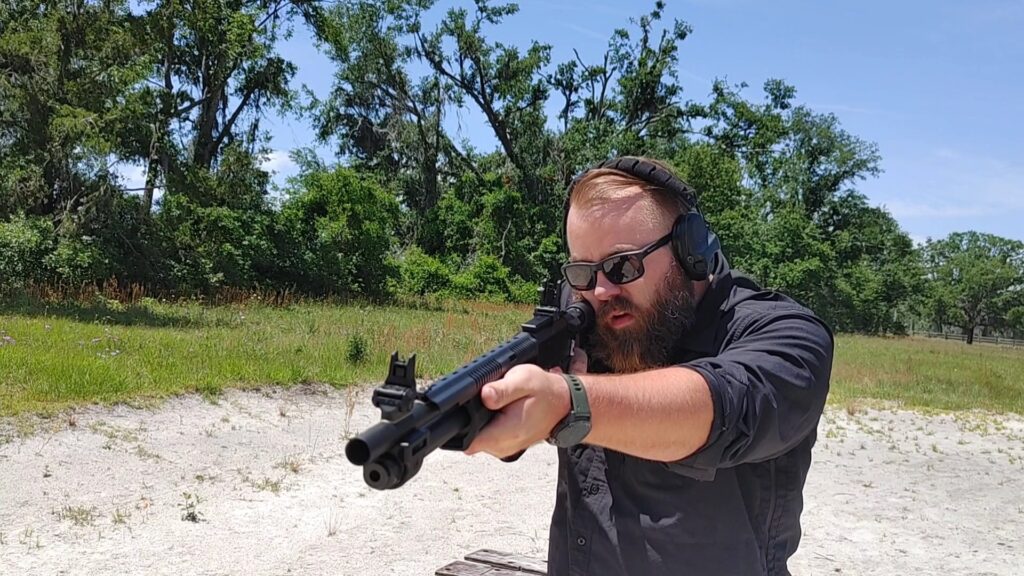
Practice using your sights, and your brain will take over. People call it muscle memory, but in reality, it’s motor memory.
With practice and training, you’ll be able to see your sights. Your brain can automate the response to ensure you aren’t firing wildly and point shooting. At this point, I can’t draw and not see my sights. Trying to point shoot is difficult because my brain has automated finding the sights.
When I draw, the sights are right there; I can’t miss them. You might argue, “Well, it’s easy on the square range!” Well, that’s true, but during my days as a much younger man, I was involved in violent scenarios on the other side of the world. I was in numerous gunfights, and not once did I ever point shoot.
That Doesn’t Matter
Here’s the thing: that experience is anecdotal, right, so it doesn’t add much to the discussion. What matters is that it’s a fact that when you train any skill, your brain coats your neurons’ axons with myelin. Myelin helps signals move faster through your brain, increasing the speed at which the signal travels by up to 100 times faster than an unmyelinated axon.
Your cognitive load is lessened because that signal moves faster, and you aren’t thinking about the steps required to aim through your sights. The process has become automated, and you aren’t overwhelmed anymore.
Point shooting, beyond a very limited circumstance, is not a useful tactic to invest in. Learn to aim; you won’t be slower, but you’ll shoot straighter.